
Blog Details
How Companies Use Hashing for Secure Data Storage
3–4 min read
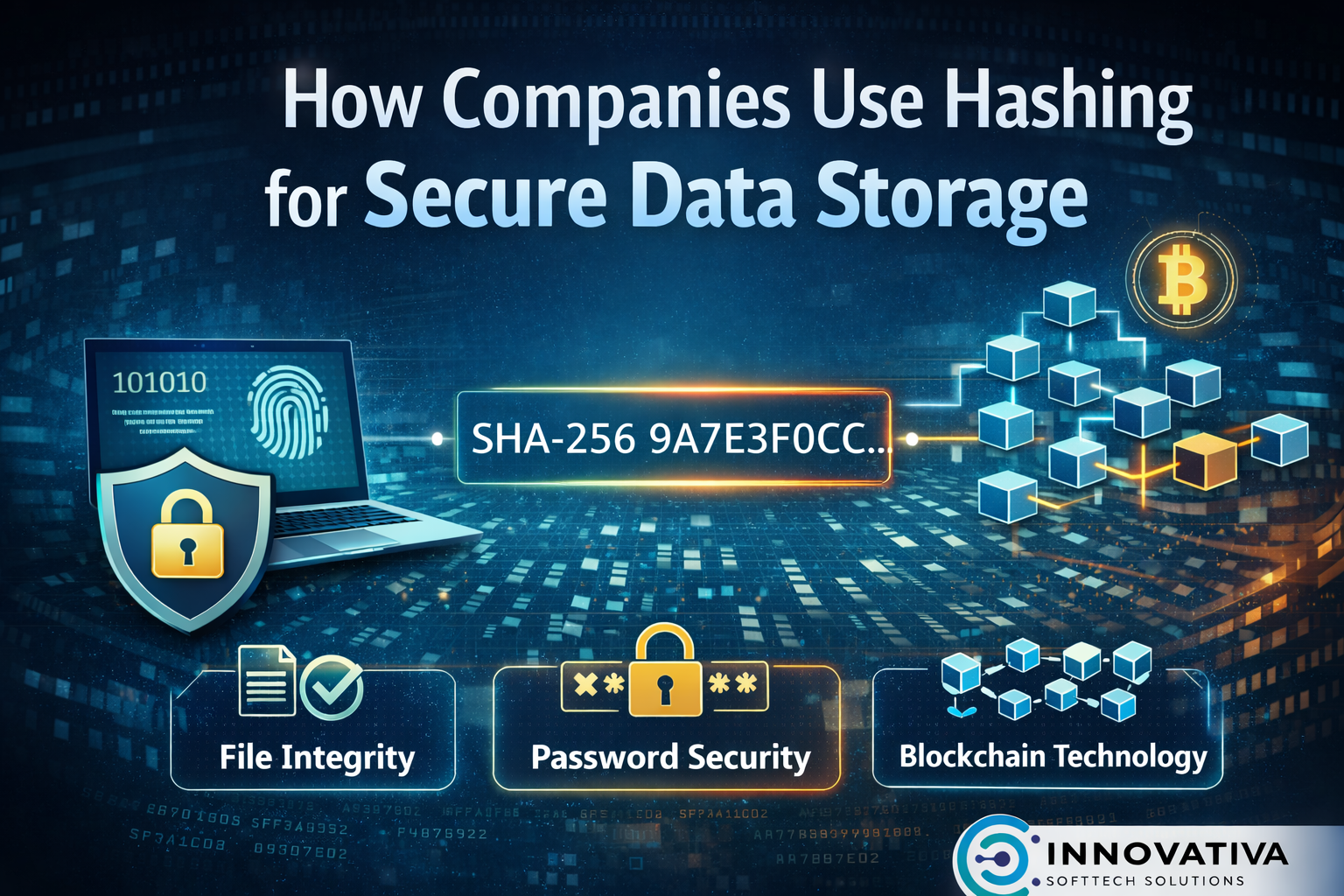
In today’s digital era, where data is considered one of the most valuable assets, companies face constant challenges in protecting sensitive information from cyber threats. From user passwords and financial records to confidential business data, ensuring security is not just an option but a necessity. One of the most powerful and widely used techniques that organizations rely on is hashing. Hashing plays a critical role in secure data storage by transforming sensitive information into a fixed-length string of characters, making it nearly impossible to reverse or misuse.
Hashing works by using mathematical algorithms known as hash functions, which convert input data into a unique output called a hash value or digest. What makes hashing particularly secure is that even the smallest change in the input data results in a completely different hash output. This property, known as the avalanche effect, ensures that hackers cannot predict or recreate the original data easily. Companies use popular hashing algorithms like SHA-256 and SHA-512 to maintain strong security standards and prevent unauthorized access.
One of the most common applications of hashing in companies is password storage. Instead of storing actual user passwords, organizations store their hashed versions in databases. When a user logs in, the entered password is hashed again and compared with the stored hash. This way, even if a database is compromised, attackers cannot directly access user passwords. To enhance security further, companies often use techniques like salting, where random data is added to passwords before hashing, making it even harder for attackers to crack them using precomputed tables.
Beyond passwords, hashing is also widely used for ensuring data integrity. Companies generate hash values for files and store them securely. Whenever a file is accessed or transferred, its hash is recalculated and compared with the original. If the values do not match, it indicates that the file has been altered or corrupted. This is especially important in industries like banking, healthcare, and software distribution, where data accuracy is critical. For example, software companies provide hash values of downloadable files so users can verify that the file has not been tampered with.
Hashing also plays a vital role in modern technologies like blockchain, where it ensures transparency and immutability of transactions. Each block in a blockchain contains a hash of the previous block, creating a secure chain that cannot be altered without changing all subsequent blocks. This makes data manipulation extremely difficult and helps companies build trust in decentralized systems.
Another important use of hashing is in digital signatures and authentication systems. Companies use hashing to verify the authenticity of messages and documents without exposing the actual content. This ensures that data remains confidential while still being verifiable. It is widely used in secure communications, online transactions, and legal documentation.
Despite its strengths, hashing is not entirely foolproof if not implemented correctly. Weak algorithms like MD5 are now considered outdated and vulnerable to attacks. Therefore, companies must choose strong hashing algorithms and combine them with additional security measures such as encryption, multi-factor authentication, and regular security audits. Proper implementation ensures that hashing remains a reliable defense against evolving cyber threats.
In conclusion, hashing has become a cornerstone of secure data storage for companies worldwide. It provides a robust, efficient, and scalable way to protect sensitive information, maintain data integrity, and build trust with users. As cyber threats continue to grow, the importance of hashing will only increase, making it an essential component of every organization’s cybersecurity strategy.